Sunday, October 27, 2024

Ford Tri-Motor Pioneers Commercial Flight

Restored Ford Tri-Motor

In today's jetsetter world, commercial air travel is taken for granted by most people, but in the 1920s the aeronautics industry had to prove itself safe before Americans felt confident enough to board an airplane and leave terra firma. It was not until Henry Ford bought the Stout Metal Airplane Company in 1924 from designer and engineer William Bushnell that public confidence in air travel rose because of Ford's strong reputation for reliability in the automobile business.

Bushnell designed a three-engined transport plane based on an all-metal Dutch plane developed by the Fokker Aircraft Corporation (Fokker F.VII). While waiting to participate in an air show at the newly constructed Ford Airport in Dearborn, Michigan, the innovative Dutch plane was stored in a Ford hanger. Ford engineers surreptitiously measured its dimensions and plagiarized the design.

Ford Motor Company (FoMoCo) created a new aircraft division and kept Bushnell on as the president of Production in 1925. At a press conference, Henry Ford proclaimed "The first thing that must be done with aerial navigation is to make it fool-proof.... What Ford Motor Company means to do is prove whether commercial air travel can be done safely and profitably."

The plane was introduced for limited excursion service as the Ford Tri-Motor in 1926. Soon, the plane became popularly known as the Tin Goose or the Flying Washboard. Only one-hundred and ninety-nine were ever produced.

Ford Airport with Henry Ford Museum in the background.

The airplane's body was clad in corrugated aluminum alloy for lightweight strength, which regrettably resulted in air drag reducing the plane's overall performance. The original Tri-Motor was powered by three 200 hp Wright engines but was upgraded to 235 hp Wright engines, and upgraded again with 300 hp radial engines. The propellers were two-bladed with a fixed pitch. The maximum air speed of 132 mph was increased to 150 mph depending on the equipped engine. The plane had a low stall speed of 57 mph. The Tri-Motor could safely reach a height of 16,500 feet with a range of 500 miles.

The Ford Tri-Motor was a combination of old and new technologies. As was common in early wooden and canvas airplanes, the engine gauges were mounted onto the engine struts outside the cockpit, and the rudder and wing flaps were controlled by steel cables mounted on the exterior of the airplane. The plane soon developed a reputation for ruggedness and versatility. It could be fitted with skis or pontoons for snow and water takeoffs and landings. The seats also could be removed to carry freight.

External cables controlling wing flaps and tail rudder.

The Ford Tri-Motor pioneered two-way, air-to-ground radio communication with their planes while in flight. Once the Department of Commerce Aeronautics Branch developed the Beacon Navigation System, a continuous radar signal was broadcast from fixed beacon locations across the country. Navigators were able to determine a plane's relative bearings by radio impulse without visual sightings, helping pilots guide their planes to their next destination.

Ford Tri-Motors were equipped with avionics that helped establish air corridors and domestic routes coast-to-coast making reliable commercial flight possible. Pan American Airlines scheduled the first international flights with service from Key West to Havana, Cuba in 1927 using Ford Tri-Motors.

Transcontinental Air Transport pioneered the first coast-to-coast service from New York to California. Initially, passengers would fly during the day and take sleeper trains at night. The first commercial planes carried a crew of three (pilot, co-pilot/navigator, and a stewardess) serving eight or nine passengers. By August 1929, the planes had a passenger capacity of twelve which reduced leg room but increased profitability.

Admiral Richard E. Byrd and supply crew-1929.

To promote air travel and the reliability of air service, Henry Ford's son Edsel financed Admiral Richard E. Byrd's flight over the South Pole to the tune of $100,000. On November 29, 1929, Byrd became the first person to fly over both poles, creating more than $100,000 worth of domestic and international publicity for the Ford Tri-Motor. Byrd left the plane in Antarctica but upon Edsel Ford's request, he retrieved the plane in 1935 and had it shipped to Dearborn, Michigan for display in the Henry Ford Museum.

The Ford Tri-Motor became the workhorse for United States and international airlines. Known as the first luxury airliner, it redefined world travel marking the beginning of global, commercial flight. American Airlines, Grand Canyon Airlines, Pan American, Transcontinental Airlines, Trans World Airlines, United Airlines, and smaller carriers flew Ford Tri-Motors. A round trip excursion ticket from Ford Airport in Dearborn to the Kentucky Derby in 1929 cost $122 with one stop for fuel in Cincinnati.

Typical excursion advertisement to promote air travel.

The aircraft industry underwent rapid development in the 1930s when a new generation of vastly superior planes like Boeing's 247 and the Douglas DC-2 began to dominate the commercial aviation market. The Tri-Motor had declining sales during the Great Depression and was losing money, so FoMoCo closed its airplane division on June 7, 1933. The company chose to concentrate on its core business--automobiles. On a human level, the death of Henry Ford's personal pilot Harry J. Brooks during a test flight made Ford lose interest in aviation.

Originally designed as a civil airplane, the Ford Tri-Motor saw military service in World War II in the United States Army Air Force. It is believed only eight of these classic planes are airworthy today. In popular culture, it was a Ford Tri-Motor that appeared in the film Indiana Jones and the Temple of Doom leap-frogging across the map.

Ford's Willow Run B-24 Bomber Plant

Saturday, October 19, 2024

Remembering Detroit's Qwikee Donut and Coffee Shops


A young, optimistic Russian blacksmith named John Weise migrated to Detroit in the late 1920s, just in time for the Great Depression. Its stranglehold on manufacturing hit the automotive blue collar workforce particularly hard. Nobody was hiring blacksmiths.

Weise struggled but found work where and when he could, learning English as he went along. By 1938, Weise decided to take a risk and go into business for himself. He borrowed some money, bought some equipment, and went into the doughnut and coffee shop business which would eventually make him a wealthy man. 

Weise named his new business The New Era as an optimistic gesture for shaking off the bad luck he had experienced in America during his first decade here. His first retail shop was on Bates St. at Cadillac Square. Because of the war in Europe, Detroit factories and businesses were once again bustling with activity. His foresight paid off. The shop was packed from its opening day with customers lining up outside for a quick and inexpensive breakfast.

In 1942, Weise partnered up with Frank Reed and together they opened a second, larger operation in the lobby of the Hammond Building. Both of the shops were branded as Qwikee Donut and Coffee Shop. The new name with its quirky spelling was an effective marketing detail emphasizing their speed and convenience. Their trademark name on their bright, neon signage lit up even the grayest, bone-chilling Detroit mornings.

High-rise office workers soon discovered they could pop in and out in minutes for hot coffee and warm donuts. Downtown shoppers found a convenient place in the shopping loop to take a break and grab a quick bite with some fresh brewed coffee. Qwikee hot chocolate with whipped cream was a favorite with kids in the winter.

"Get Your Daily Dozen" was their slogan.

Space was limited in the early shops and restaurant seating took up too much space. The pace of life downtown quickened when the United States entered World War Two. Frank Reed had the idea to install stand-up counters along the walls for their busy customers. Daily editions of the Detroit News, the Free Press, and the Times were enclosed behind glass cases mounted across the walls for the convenience of customers who preferred to stand, slam down a quick cup of coffee and a doughnut, read the headlines, and dash off to work. Reed's second location served 5,000 to 6,000 customers daily.

With the demolition of the Hammond Building in 1956, Weise and Reed opened another larger shop on Grand River Boulevard at State Street. Soon other shops opened. There was one at 222 W. Congress St., one in the Guardian Building, one in the Fisher Building, and the largest shop at State and Griswold St. At that location, sandwiches and warm lunch plates were dispensed with self-service automat machines. Hot dishes with gravy like meatloaf, roasted chicken, and roast beef were popular menu items.

Qwikee Donut expanded their menu to include sandwiches and soups and adopted a cafeteria-style format. At the height of their popularity, Qwikee Donuts numbered five or six locations in the downtown loop serving 20,000 dozen donuts a week. The Grand River Avenue location became a hangout for generations of Cass Tech and other students looking for a warm, dry, convenient place to wait for the bus home which might take over an hour. Since it was after the lunch rush, the owners welcomed their steady business. Better to have customers than an empty shop.

The local doughnut chain became famous for their large, warm, and delicious donuts. You could get them plain, powder-sugared, cinnamon-sugared, iced with chocolate, vanilla, cherry, or orange frosting. Others were glazed and dipped in chopped nuts. They also served jelly and custard-filled doughnuts. Custard-filled were only served in the winter because the summer heat was too dangerous. The filling might spoil and make people sick.

Qwikee Donuts also served sandwiches and soups. Bean and pea soups were popular in the winter, and lighter soups like French onion were served in the summer. Chicken noodle and chili were year-round favorites. All soups were served in crockery bowls. Food was served on plates, and the utensils were stainless steel--never plastic. Sandwiches were traditional and served on sliced white or whole wheat bread from the nearby Wonder Bread bakery. Peanut butter & jelly, egg or tuna salad, and ham, turkey or roast beef with cheese were the standard sandwiches.

Weise and Reed together may have helped revolutionize the fast food business. Their most notable neon marquee sign was mechanical and one of the top three greatest signs in Detroit behind the Vernor's Sign on Woodward and the red and yellow neon, pulsating Flame Show Bar entrance in Paradise Valley. The Qwikee Donut sign had a hand dunking a doughnut into a simulated, steaming cup of coffee, all outlined in neon. That doughnut went up and down all day and never got soggy! The bright sign, co-mingled with the smell of warm doughnuts and freshly brewed coffee, was irresistible.

Original Quikee Donut owner John Weise.

When the Detroit Free Press interviewed John Weise in 1959, he said, "An office boy or girl can come into (our shops) and pick up a dozen cups of coffee and a bag of doughnuts for the entire office staff and be back (to work) before the boss (realizes they are gone)." 

John Weise and his partner Frank Reed parlayed their original shops into a million-dollar enterprise that became part of the fabric of downtown Detroit's daily life for decades. When Frank Reed suffered his first heart attack in 1956, he sold his interests in the company to his partner Weise. 

Sometime in the 1960s, Weise sold his interest in Quikee Donuts to Joe Hermann and Sons who were in the baking business. Thereafter, he retired. With the decline of downtown business activity in the seventies and eighties, and the loss of downtown shoppers to suburban shopping centers, Qwikee Donuts downtown went quietly out of business in the mid-1980s.

I was told by former Quikee Cafeteria employee, Chris Bosley, that the Hermann family, Albert, his wife Judy, and his sons Rick, Scott, and daughter Shelley, took their company with their new branding to the suburb of Southfield in the late 70s or early 80s.

They closed their downtown operations but kept the commissary on Grand River Avenue open to supply their cafeterias with fresh made doughnuts, soups, and sandwiches which they delivered daily to their various locations. The cafeterias were popular and stayed in business until the early 2000s when Albert retired and sold off the business.

***

Founder John Weise died at the age of fifty-three on Monday, October 3, 1966, leaving behind his wife Gilda, his sister, three daughters, and three grandchildren. Mr. Weise is buried in White Chapel Memorial Park Cemetery in Troy, Michigan.

Co-founder Frank Reed suffered a heart attack aboard the ocean liner Queen Elizabeth II en route to Great Britain to begin a European tour. Mr. Reed died August 16, 1979 at the age of seventy-seven leaving behind his wife Hazelle, two brothers, and a sister. He is buried in Palm Beach, Florida.

White Castle Rules

Friday, September 27, 2024

Samuel Zug - The Man Behind the Island

Samuel Zug
Samuel Zug is thought by some people to have been an industrialist, but that couldn't be further from the truth. He was a devout Presbyterian who took an interest in politics and human rights.

In 1836 at the tender age of twenty-years-old, Samuel Zug came to Detroit, Michigan from Cumberland County, Pennsylvania. Using money he saved as a bookkeeper in the Pittsburgh area, he went into the furniture making business with Marcus Stevenson, a Detroit investor.  

The prospect of endless stands of pine, oak and maple trees as raw material, and convenient access to Eastern markets by way of the Detroit River for their finished products made Detroit an ideal place for a young man to make his fortune. 

But in 1859 after twenty-three years in the furniture business, his partnership with Stevenson was dissolved leaving Samuel Zug a wealthy man to pursue real estate and political ambitions.

In 1859 (or 1876 depending on which source you choose), Samuel Zug purchased 325 acres of land along the Detroit River from Michigan's second Territorial governor, General Lewis B. Cass. Over 250 acres of the parcel was marshland with a sulfur spring bubbling up 1,200 barrels of mineral water a day.

The marshy peninsula of land was a part of Ecorse Township before it became the city of River Rouge. In unrecorded time, the land was rumored to be an ancient burial site for a number of native American tribes known to inhabit the area.

Samuel Zug and his wife Anna built a home on the island, but after ten years they decided that the marshland and natural sulfur spring on the site proved too much for them to endure. The Zugs surrendered the land to the red fox, water fowl, muskrats, and mosquitoes. The croaking frogs and singing insects were left to serenade the damp night air because the island was virtually uninhabitable.

In 1888, Samuel Zug authorized the River Rouge River Improvement Company to cut a small canal at the south end of his land. Known by locals as Mud Run, it was dredged out sixty feet wide and eight feet deep. 

Short Cut Canal at bottom of map was Mud Run.

The Zug family peninsula became a man-made island overnight separating it from the north end of Ecorse Township. The channel improved the flow of the Rouge River into the Detroit River, but it did little to circulate water around the newly formed island, leaving a slow-moving backwater.

On December 26, 1889, Samuel Zug died leaving his holdings to his wife, Anne, who died on June 10th,1891. It has been reported wrongly that Mr. Zug died in 1896. My source for the correct date of Zug's death comes from his tombstone in Detroit's Elmwood Cemetery.


The Zug heirs sold the island for $300,000 to George Brady and Charles Noble, who wanted to use the site for an industrial dumping ground. The island was diked with interlocking steel panels and back-filled with construction rubble and dredging waste to raise the ground above the water table and reclaim the land from its natural state.

Heavy industry was about to move onto the island but Mr. Zug never lived to see it. The island's namesake was "Waiting for the Coming of Our Lord" as the inscription on his grave marker proclaims.

In addition to being a bookkeeper and the owner of a successful furniture manufacturing company, Samuel Zug also is credited with being one of the founding members of the Republican Party, which was considered to be the progressive party of the day. Their first official meeting took place on July 6, 1854, in Jackson, Michigan.

The Republicans were an abolitionist party that came to national attention when they won 33% of the presidential vote from the Democrats and the Whigs in 1856. Four years later in 1860, they broke through the two-party system and elected Abraham Lincoln to the White House.

Samuel Zug was an anti-slavery advocate long before Lincoln was elected and The Civil War began. He bought and set aside a parcel of land for refugee slaves in the city of Amherstburg, Ontario, Canada, a destination of the Underground Railroad. What other support he gave to the Abolitionist Movement is shrouded in the dim history of time and whispers of the unrecorded past.

At the time of his death, Samuel Zug was unaware of the mighty industrial complex his soggy marshland would become. He would never know the history Zug Island would make possible or the long-term environmental impact the steel industry would have on the area and its people.

In Detroit's Elmwood Cemetery


Saturday, September 21, 2024

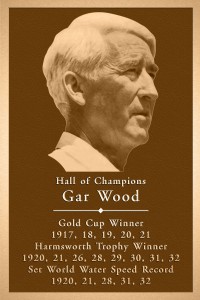
Detroit's Speedboat Champion Gar Wood

Garfield "Gar" Wood
One of the least remembered Detroit sports celebrities is speedboat champion Garfield "Gar" Authur Wood. He was known as the "Grey Fox of Algonac" by many in the speedboat racing world. He was the first person to go over 100 mph on the water. Gar Wood won five straight powerboat Gold Cup races between 1917 and 1921. He won the British International Trophy for Motorboats known as the Harmsworth Trophy nine times and retired from speedboat racing in 1933 to concentrate on business concerns.

Gar Wood was born in Mapleton, Iowa on December 4, 1880. His father was a patriotic Civil War veteran and named Gar after the current president James A. Garfield and his vice-president Chester Arthur. Gar was the third of twelve children. As a growing boy, Gar assisted his father who was a ferryboat operator on Lake Osakia in Minnesota. It is here where he learned his love of boating and developed his mechanical skill for inventing devices to solve mechanical problems.

Without any formal engineering training, Gar Wood invented the hydraulic lift for the titling beds of coal trucks in 1911 at the age of thirty-one. In addition to the dump truck, his company developed the self-packing garbage truck familiar in every corner of this country. In all, Gar Wood held over thirty United States patents making him a multi-millionaire by the age of forty.

Gar Wood and his eight brothers established the Wood Hoist Company which soon became Garwood Industries. Alongside industrial giants like Ford, Dodge, and Chalmers, the family built an industrial empire around the hydraulic lift which enabled Gar to pursue his love of speedboat racing.

In 1916, Gar Wood purchased his first motorboat naming it Miss Detroit. The following year he put a Curtiss "12" airplane engine in a speedboat against the advice of everyone and won the 15th Annual Gold Cup Race on the Detroit River. Fours years later, he set a new water speed record of 74.87 mph. In the next twelve years, he and his racing team built ten Miss America's and broke the water speed record five more times raising the speed to 124.86 mph on the St. Clair River in 1932.


Miss America X was the last of Gar Wood's racing boats. The $600,000 speed boat was powered by four 1800 horsepower, twelve cylinder Packard engines run in tandem in a double-hulled boat. The boat's stringers were made of top quality spruce with the rest of the boat made of mahogany. This was the first boat to go over two miles a minute using 10 gallons of fuel per mile when full open. After Wood won the international Harmsworth Trophy in 1932 and 1933, he retired from racing leaving his son to carry on the family tradition. Gar Wood did more to develop the American speedboat sport than anybody.

In the 1930s, Garwood Industries built a new boat plant in Marysville, Michigan capable of producing 1,200 quality custom boats a year. Their two basic commercial models were a 28' runabout and a 22' runabout. In all, the factory produced 10,000 boats before the company converted over to the war effort during World War II. The company had extensive military contracts for military hoists, hydraulic units, dump trucks, tow trucks, and transport trucks. After the war, Garwood Industries quit boat production in 1947.

In his later years, Wood worked on a commercially feasible, battery-powered electric automobile. His electric car used eight 12-volt lead batteries connected in a series to power two specially designed 90-volt, 2 hp DC motors. The top speed was 52 mph and cost about twenty cents to recharge the batteries. The car was named the Gar Wood Super Electric Model A and was featured in the July 1967 issue of Popular Mechanics.


Garfield Arthur Wood died from stomach cancer at the age of ninety on June 19, 1971 and was buried in Algonac, Michigan. Upon his death, Detroit News reporter George Van wrote, "To the public, he was Tom Swift, Jules Verne, and Frank Merriwell, with a little bit of Horatio Alger thrown in."

A short clip of Miss America X and Gar Wood in action winning the Harmsworth Trophy in 1932.
https://www.youtube.com/watch?v=CMlahrYMF74

Saturday, August 10, 2024

Brave New World of Betty Boop

Classic Betty Boop Sketch
Betty Boop was a music novelty character who was a sex symbol during the Great Depression. She was a caricature of Roaring Twenties flappers--young women who smoked cigarettes, drank alcohol, drove cars, and danced the Charleston in speakeasies. Betty Boop became known as the "Boop-Oop-a-Doop girl." Her personality can best be described as moxie.

Max Fleischer with his creation.
Betty was a creation of Max Fleischer Studios targeted for an adult movie audience during the 1930s. She wore short dresses, high heels, garters, and contoured necklines. Betty's "innocent sexuality" was a mixture of girlish naivete and vampish allure which some people would define as infantilizing women.

In 1932, jazz singer Cab Calloway performed in the famous film short "Minnie the Moocher" singing that evocation song while the video blended into a Betty Boop animation which defined her character and made her a star. This musical short was one of the original music videos and the song became Calloway's signature theme song for subsequent stage appearances.

As Betty's popularity progressed, many of her early cartoons found her fighting off predatory men trying to compromise her virtue, making some modern American women view Betty as a feminist icon against sexual harassment. By 1934, the Hayes Production Code forced animators to tame the Boop character by making her a ambitious career girl trying to make it in the big city. She began wearing appropriate business attire and less jewelry. The newer cartoons lost their edge and their popularity--the last of the original cartoons was made in 1939. The Betty Boop series gained a new audience when her cartoons were released for television making Betty an American cartoon superstar.


Helen Kane
Betty's "baby doll" voice was similar to the voice characterization of actress Helen Kane whose musical comedy stage career had faded by 1931. Kane brought a $250,000 infringement lawsuit in 1934 against Paramount Pictures for "deliberate caricature exploiting her personality and image."

Esther Jones
During the trial, it was discovered that African American cabaret performer Baby Esther (Esther Jones) used a similar vocal style in her Harlem Cotton Club act. Even the scat "Boop-Oop-A-Doop" was created by Jones as a vocal jazz improvisation. An early jazz novelty short film was found featuring Baby Esther performing her "baby doll" style. The New York Supreme Court ruled that the "baby doll" technique did not originate with Kane. 

Six different actresses portrayed the voice of Betty Boop. Two of them--Margie Hines and Mae Quistal were also the voice of Olive Oyl in the Popeye cartoons of the same era. 

Although the series ended in 1939, Betty's character appeared in two television specials in the 1980s, and she made a cameo appearance in the feature movie Who Shot Roger Rabbit? in 1988. Her image is still popular worldwide and has become a merchandising goldmine for King Features Syndicate.

Link to "Minnie the Moocher"

Saturday, August 3, 2024

Hoarders Henry and Clara B. Ford

Clara B. and Henry Ford

After Mrs. Clara Bryant Ford died at the age of eighty-four on September 29, 1950, lawyers, executors, and archivists discovered in the Ford family's Fair Lane mansion a massive accumulation of memorabilia and business documents tucked away in shoe boxes, desk drawers, file cabinets, and dressers.

Among their findings in the fifty-five room, greystone mansion were records from the earliest days of the Ford Motor Company (FoMoCo), 25,000 assorted photographs, bales of greeting cards tied with string, blueprints, contracts, maps, legal documents, personal letters, magazines, newspaper articles, and Henry Ford's "jot books."

Archivists filled 24 document boxes with Christmas cards alone and another 11 boxes with financial receipts for common household expenses from 1889 to 1950. Also found lying around carelessly was $40,000 in loose cash, 10,000 unopened letters, and many uncashed dividend checks.

Fair Lane Mansion

In their fifty-nine-year marriage, Henry and Clara lived in twelve different places before they built Fair Lane, and apparently neither of them ever threw anything away. Collectively, the treasure trove of documents was dubbed the Fair Lane Papers and occupied more than 700 feet of shelf space in double-tiered, steel document racks installed above the filled-in indoor swimming pool at the mansion. A full-time staff of sixteen historians, librarians, and archivists was hired by the Ford Foundation to organize and catalogue this vast, new documentary resource.

The operation was split into two units. The Records section was led by Dr. Richard Ruddell, a professional librarian whose team cataloged, annotated, and microfilmed over five million perishable papers and photographs. Their offices were on the main floor at Fair Lane.


The Living History section was led by Dr. Owen Bombard of Columbia University. His office was the master bedroom upstairs where Henry Ford had died six years before. The combined objective of both units was to assemble a rounded picture of the late industrialist.

Dr. Bombard set out to capture the living history about Henry Ford by interviewing and recording three hundred people who knew Mr. Ford. Participants were asked to share their tape recorded memories of the auto magnate. Only five people declined the invitation. Two people said they had nothing significant to add, and three former FoMoCo employees harbored resentment against the old man and did not want to be recorded.

On May 7, 1953, Detroit Free Press feature reporter Ed Winge asked Dr. Bombard in a interview if former Ford security chief Harry Bennett would be invited to record his memories for the oral history project. Bombard cautiously replied, "Bennett hasn't been approached yet. But he may be contacted in the future if it is felt that he has something to contribute."

For background, Harry Bennett published his autobiography in 1951 titled We Never Called Him Henry about his controversial years as Mr. Ford's right-hand man and company enforcer. The Ford family was united in their contempt for the former Ford Security chieftain, although a copy of his book is one of many books written about Henry Ford in the archive's collection.

Throughout the1920s and 1930s, Henry Ford was the world's best known American citizen. Because of the intense public and world interest in the enigma that was Henry Ford, his decendants opened the Fair Lane archives to historians, scholars, and authors. The Fair Lane Papers collection has since moved to the Benson Ford Research Center adjacent to Greenfield Village.

Henry Ford's Tough Guy--Harry Bennett 

Friday, July 5, 2024

The Long-Awaited Ambassador Bridge Connects Detroit with Windsor

Ambassador Bridge Announcement--Detroit Free Press

When the automobile business took off early in the twentieth century, the need for an international bridge connecting Detroit with Windsor to expand the auto industry and increase international commerce became apparent, but securing government funding for the bridge project was a hard sell fraught with political red tape and delay. The highest-profile person supporting the bridge project was automobile magnate Henry Ford. "The only way to get things done today is by private business," Ford said.

A team of Detroit business leaders incorporated the Detroit Bridge Company and sought out a former Detroiter, successful New York City banker Joseph A. Bower. Bower sold securities to finance the project and was able to raise $23.5 million in privately financed funds, including his own investment.

The project details were presented to the Detroit Common Council and approved unanimously. But one dissenting voice vetoed the project, Mayor John W. Smith. In additional to several ambiguities in the project's prospectus, including revenue for the city of Detroit, Smith was rightly concerned that the bridge deck would only be 135' above the Detroit River.

Mayor Smith, mindful of the future, realized that 135' would limit future navigation of larger freighters. The project engineers went back to the drafting table and re-engineered the bridge to be 152' above the water.

Recognizing the long-term value of the bridge and the threat any further delays might pose to the overall project and his substantial investment, Bower assumed the $50,000 cost of a referendum in a special election supporting bridge construction. The referendum passed by an eight to one margin on June 28, 1927. The next month, McClintic-Marshall engineering firm was awarded the bridge contact which ran from August 16, 1927 until August 16, 1930.

The penalty for late completion would require the firm to pay the interest on the securities until the bridge could generate revenue. If they finished construction early, they would be entitled to half of the bridge's revenue until the official end of the original contract. The newly christened Ambassador Bridge opened six months ahead of schedule despite having to change out the original suspension cables which were found to become brittle in freezing weather. They were quickly replaced with cables spun with stronger cold-roll steel. Still, the bridge cost came in 1% under the original budget allocation.

When finished, the Ambassador Bridge was 1.5 miles long, requiring 21,000 tons of steel. The clearance from the Detroit River was 152' but the bridge's roadway never rises above a gentle 5% grade. The four-lane roadbed (two coming and two going) was 47' wide with an 8' wide pedestrian sidewalk on the west side of the bridge. The bridge was anchored on the American side on West Jefferson and 21st Street. On the Canadian side, the anchorage touched down on London St and Huron Line Road in Sandwich, Ontario.

Opening day ceremonies coincided with Armistice Day (Veteran's Day) Monday, November 11, 1929. An estimated 100,000 from both sides of the Ambassador Bridge were on hand to cheer the ceremonial opening. With much pomp and circumstance, dignitaries from both countries held cermonies on their respective sides of the bridge. At 3:15 pm, Canadian bands played patriotic selections such as "God Save the King" and "Oh Canada," while at the same time, American bands on their side played tunes like "America" and "The National Anthem."

Following the musical programs, speeches were made by dignitaries on both sides of the bridge. Then, bronze "Friendship Tablets" designed by New York sculptor Jonathan M. Swanson were unveiled on the anchorages on both sides of the bridge. The plaques celebrated more than 115 years of friendship between the United States and Canada. The ceremony ended when dignitaries met at the exact international boundry. They shook hands and cut a white, silk ribbon. Then in concord, sirens and fog horns of river craft sounded continuous acclamation while many airplanes soared and circled above the bridge.

The bridge was originally scheduled to open in 1930 which is what the plaques reflect.

In what only can be described as a loosely controlled riot, joyous crowds on both ends of the bridge swarmed the deck. When the roadbed became so crowded that people could not move, some of the braver revellers climbed the construction catwalks on each side of the bridge to the top of the piers. It took well into the night before the bridge was cleared and secured again.

Photo from Windsor Star.

Four days later, the Ambassador Bridge opened for business. The opening was signaled by the passage of two cars filled with dignitaries from each country that left simultaneously from each side of the bridge. They honked in friendship as they passed at the center of the bridge and a signal cannon boomed to officially open the bridge to the toll-paying public. Cheers and applause broke out on both ends of the bridge.

The Ambassador Bridge was now officially open. An estimated 235,000 persons crossed the bridge the first day--35,000 of them were pedestrians. Traffic was backed up almost two miles on each bridge approach with people wanting to claim bragging rights that they had crossed on the first day.

On opening day, American customs officials reported that eleven quarts of whiskey were seized in three separate incidents. Prohibition was still in effect on the American side. At 8 pm, a man carrying four quarts, and at 9:15 pm, a woman carrying six quarts were detained by customs inspectors. Both people used the same excuse, they needed the whiskey to make holiday fruit cake." Just after 11 pm, a single quart was found tucked under the back seat of a car.

It was determined by customs agents that none of the instances was a commercial violation. The smuggled Canadian liquor was confiscated and the offenders were released after paying a $5 fine for each quart.

The Ambassador Bridge had the misfortune of opening just twenty-one days before the Great Depression struck. To compound the misery of the bridge's investors, the new Detroit-Windsor Tunnel opened downtown the following year charging lower automobile tolls. One factor remained in the bridge's favor though, the Detroit Bridge Company held a monopoly as the only Michigan international crossing for the commercial truck business.


When World War II broke out just over a decade later, American gas rationing dramatically cut automobile bridge traffic, but commercial truck traffic increased due to the war effort. In 1944, two years into the United States entry into the war, the Ambassador Bridge became profitable for the first time. Investors were paid 75 cents per share which began an unbroken stream of dividends every year since.

Gordie Howe International Bridge