Showing posts with label Detroit Free Press. Show all posts

Saturday, August 8, 2026

Lou Gordon "The People's Champion"

Lou Gordon--Detroit Crusader

Detroit political commentator Lou Gordon died 
in his sleep from a heart condition in his Bloomfield Hills home early Tuesday morning, May 24, 1977. Detroit Free Press columnist Billy Bowles described Gordon as a "feisty interviewer who was a power to be reckoned with by Michigan politicians."

Lou Gordon was born in Detroit on May 17, 1917, and was a product of Detroit public schools. He graduated in 1935 from Central High School on Tuxedo Street. Gordon attended one term at the University of Michigan, but this was during the Great Depression. He quit college to work as an insurance agent for United Life Accident Company. During World War II, Gordon became an air cadet and served for two years in the Army Air Corps.

After the war, Gordon returned to the University of Michigan on the G.I. Bill and earned a degree in journalism. He landed a job with the Booth Newspaper chain in Washington D.C. as a political reporter. There he met and became friends with famous liberal columnist Drew Pearson, who greatly influenced Gordon's development as a political pundit. Gordon was willing to take dangerous assignments dealing with organized crime figures and political corruption and soon began to make a name for himself.

When his father died in 1950, Lou returned home to Detroit to take care of his mother. To make a living, he became a district sales representative in Detroit for the White Stag sportswear line. He increased the firm's local business ten fold from $150,000/yr to $1.5 million/yr. 

Through commissions, bonuses, and shrewd investing, Lou became independently wealthy, but he missed the rush and excitement of his journalism career. Gordon told Detroit Free Press reporter Billy Bowles once in an interview, "My heart was never in the sales business. I longed for the old days of politics."

In 1957, Gordon was hired by local Detroit radio station WXYZ as a political commentator and soon began building a fan base. WXYZ management realized Gordon's ability to attract an audience. He had an engaging smile and cast a strong media image. Gordon wore impeccably tailored suits and never looked less than his best. The station manager offered Lou a fifteen minute spot (10:45 pm - 11:00 pm) every weeknight called Detroit Deadline. Lou would discuss a single issue and interview a guest, often a local politician or community leader. Gordon did this for seven years.

The show was so popular that rival Detroit start-up station WKBD-TV (Channel 50) lured Lou away with a better offer in 1966. The station offered Lou his own ninety-minute show to air at 10:00 pm over the weekend on Saturday and Sunday nights. The Saturday night show discussed local Metropolitan Detroit issues which rankled and alienated people from across the political spectrum. On Sunday nights, the program discussed national political issues with any politicians or journalists who were brave enough to be his guests.

The Lou Gordon Program debuted in September of 1966. The background music heard under the program's title card was the instrumental interlude from the popular song "MacArthur Park." Lou would appear onscreen and say, "Welcome to the program, where there are no cue cards, no teleprompters, no idiot boards, just ad-lib conversation where we tell it like it is."

From the program's onset, Lou Gordon vowed "to speak out against social injustice and become the champion and voice for the common man." Working-class and middle-class Detroiters, aged 35 and above soon became Lou's loyal audience, especially when he took on the local utility companies accusing them of ripping off the public.

Modern television viewers are accustomed to the blood sport that modern politics has become. But in 1966, there was nothing else like The Lou Gordon Program on weekend, late night TV. Lou enjoyed drawing his guests into a lively conversation and carefully watching them for weak spots in their arguments before pouncing. Then, he would spring a "gotcha" moment on them.

Lou Gordon and his staff read many newspapers and political magazines from around the country researching them daily. When confronted with evidence, some guests would simply deny the facts, but they did so at their peril. Lou was prepared, even over-prepared some said. Other guests became angry or simply walked off the set mid-interview, and some would attack Lou, his facts, and his methods. All of it was good television.

George Romney -- GOP hopeful.

What brought Lou and his program to national attention was an interview he did with former Michigan governor George Romney. Romney was a front runner in the Republican party to be their standard bearer for the presidency in 1968. During the interview, he came out against the war in Vietnam saying, "When I went on a fact-finding tour of Vietnam, the generals and the United States diplomatic corps tried to brainwash me."

Despite agreeing with Romney's position on the war, the newshound in Gordon recognized that Romney's careless use of the term "brainwash" was politically provocative and headline news. Because of the limited scope of WKBD's reach, Gordon called Detroit's New York Times bureau chief Jerry Flint and gave him the full transcript of the interview.

The Times ran the brainwashing remark as their headline and distributed the story on the news wire services. The national nightly news TV programs broadcast the story the next evening and most newspaper chains ran the story coast-to-coast in their morning editions. Shortly afterward, George Romney withdrew from the presidential race.

Lou Gordon's sudden national recognition prompted WKBD's owners to syndicate his show across all of their seven United States markets creating the first nationally recognized late night news discussion program. In 1971, the Lou Gordon Program could be seen in Detroit, Chicago, Cleveland, Boston, Philadelphia, San Francisco, and Los Angeles.

With today's internet technology, once a program file is created, a single person can send it to as many places as necessary with a database and a single key stroke. But in the early 1970s, VHS video tapes were recorded, copied, and send to each media market separately via the United States Post Office. This was labor and time intensive. The syndication gamble paid off. Lou's program became especially popular with the Los Angeles Hollywood crowd which helped him book celebrity guests.

As if Lou was not busy enough producing his own show, he also wrote a twice weekly political column for The Detroit News. His obsession with politics seemed limitless. Lou was truly a workaholic who loved what he did for a living.

The Lou Gordon Program ran for twelve years. At the top of his game, Gordon died in his sleep at his Bloomfield Hills home on May 24, 1977. Lou succumbed to complications of an aortic valve replacement. He was only sixty years old. Gordon left behind his wife Jackie and their five children: Carol, Debbie, Jon, Ruth, and Scott.

Lou and Jackie Gordon. Jackie would read Lou questions early in the broadcast sent in by viewers.

On Friday, May 27, 1977, the Detroit Free Press reported on Lou Gordon's funeral service at the Ira Kaufman Chapel, attended by an overflowing crowd of nearly 700 people. Many statewide political people as well as local television celebrities like Bill Bonds, Bill Kennedy, and Sonny Eliot paid their final respects.

The oak casket had a sculpted Star of David carved into the lid. Jackie dressed in a white belted dress and dutifully greeted a long line of friends in a small, private reception room. Afterward, a black hearse took Lou Gordon to his final resting place, Clover Hill Park Cemetery in Royal Oak, followed by a gray limousine carrying Jackie and her family. 

Tuesday, February 7, 2023

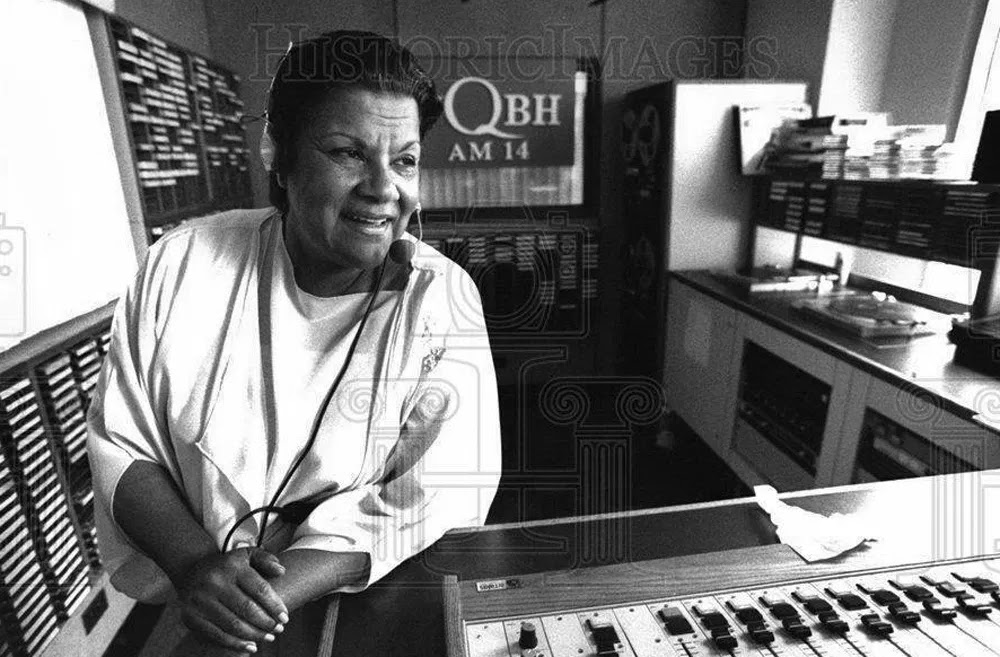
Martha Jean the Queen—Patron Saint of Blue Collar Detroit

Martha Jean the Queen painted by DeVon Cunningham (1976) 

A couple of radio executives from WCHB-AM in Detroit were driving through Memphis on business in 1963 when they heard the voice of Martha Jean the Queen (MJQ) on their radio. They liked the Queen’s Southern accent and her facile deejay patter. These Northern radio men were in the South shopping for an African American disc jockey that could help WCHB-AM (Inkster, Michigan) capture the vast Detroit Black radio market. Most Black Detroiters had Southern roots, so it seemed like a sensible marketing strategy.

MJQ was number one in her Memphis time slot which was a notable achievement in the Jim Crow South for a Black woman disc jockey—a testament to her ability to draw an audience. These Northern radio execs called Martha Jean at WDIA–AM and offered her a raise of $30 a week if she would take her radio program to Detroit. MJQ was a recently divorced, single mother of three daughters who didn’t want to move, but Martha Jean had custody and needed the extra income, so she took the job.

Martha Jean Jones was born on September 9, 1930 in Memphis and graduated from a Catholic school. She began nursing school but the harsh realities of life and death pushed her into business school. As fate would have it, Martha fell in love with jazz trumpeter Luther Steinberg, married him, and had three daughters in quick succession. She saw her life as the manifest destiny of a young Southern Black woman, a child of poverty, followed by a volatile marriage, bondage to babies, and a lifespan of degradation by Whites.

Luther Steinberg was struggling in the music business when he became abusive to Martha Jean, so she divorced him. “There are two things I can’t stand,” she said commenting on her failed marriage in a Detroit Free Press feature article on January 10, 1982, “a man who is cheap and a man who runs around on his woman.”       


Martha Jean used the power of positive thinking to pick herself up and provide for her children. “We should all try to see the beautiful side, the positive side (of life),” she said, “but the ugly side has been with us as a people for a long time and with me personally as a divorced woman with children.”

Martha Jean Steinberg became a receptionist for Memphis radio station WDIA-AM. Because she had a pleasing manner dealing with everyone who walked through the door, the station manager gave her a try on the radio in 1954 as a substitute for an ill disc jockey and she stayed there for nine years learning the radio business and earning the title The Queen. Her patented tagline "You betcha!" after she read advertising copy was like money in the bank for advertisers.

In a May 21, 1967 Detroit Free Press Sunday interview, MJQ was asked what her radio name “The Queen” meant to her. In figurative deejay fashion she answered, “I was written in the sands of time 5,000 years ago, endorsed and smiled upon by the gods. I have a purpose, and I’m on my way to fulfill my purpose…. I am the Queen of the people, they are my purpose.”

When MJQ came to Detroit, WCHB wanted her to play easy listening rhythm and blues and read advertising copy. MJQ’s Homemakers Delight program ran from 10:00 AM until 12:00 PM for three years. One of her early challenges was the perception that she sounded too White to project the Black image over the airwaves. “I had to get down with it to prove I was Black enough and find my place in Detroit’s Negro community, so in many ways, I had to act and sound more colored than colored. Detroit had long been a haven for jazz musicians, so I introduced jazz to my musical lineup and my audience grew.”

MJQ became known for supporting women’s rights throughout the 1960s reminding blue collar wives when it was payday at the Ford plant or Great Lakes Steel—the two largest employers of Black men in the Detroit area. “Get that check from your man before it disappears, ladies.” Martha Jean was proud of herself for making it without "the crutch of a man.” She never forgot the desolation of being left alone with three daughters and no money. The Queen was an inspiration to her soul sisters in the audience.

Unsatisfied with her limited role at WCHB, MJQ jumped stations again when WJLB-FM offered her more money, air time, and freedom to co-produce her own programming. In addition to playing music, she added a fifteen minute call-in segment named Tasting Time where she gave her daily salute to blue collar people around the Detroit area.

In a Detroit Free Press feature article on October 23, 1966, MJQ explained her move, “WJLB-FM will give me a better opportunity to serve my people and do things for them. The secret of my success in Detroit are the people—the forgotten blue collar workers. I like and enjoy people. I feel a disc jockey has command of so many hearts and minds…. I give my listeners a positive reality and that surge of hope necessary to exist. I feel my day is in vain if I can’t touch someone or lift their spirits.

“In my own Southern way of talking, a lot of people started listening to me. My positive message gives people self-confidence to accomplish whatever is challenging them. I’d play blues, and between each bar of a song, I’d talk without interfering with the lyrics and say things like ‘Hey! You cats at Kelsey Hayes’ or ‘You guys in the hole on Ecorse Road’ when the Wayne County Road Commission was working on the roadway. These blue collar workers were listening on transistor radios at work, and it made them feel like somebody when I mentioned them or their place of work on the air. Soon, places all over town began asking me to give them a call out over the airwaves. My slogan was ‘You’re somebody, act like it’.”


During the 1967 Detroit Riots/Rebellion, MJQ broadcast for 48 hours straight urging Black demonstrators to get off the streets and stay home. She helped police negotiate with armed Black Panthers barricaded in a house into surrending peacefully to avoid bloodshed because innocent women and children were inside. That terrible conflagration was transformative for Detroiters. From that moment onward, Martha Jean felt a responsibility to be a bellwether for her people. In the 1970s, MJQ moderated a show called Buzz the Fuzz with Detroit Police Commissioner John F. Nichols credited with improving police/community relations. Every Thursday from 7:00 PM until 7:30 PM, callers could ask Commissioner Nichols questions.

On January 11, 1971, MJQ gave a short scream into the microphone at noon, and then there was three hours of radio silence. Nine Black WJLB staff members—including MJQ—staged a sit-in by locking the studio door and barricading the plate glass front window of the station’s offices on the 31st floor of the David Broderick Tower. The on-air staff was all Black but management was all White. The staff charged that the outgoing station manager failed to live up to an earlier agreement to appoint a Black station manager to replace him. After all, WJLB’s listening audience was primarily Black. The sit-in strike ended at about 3:00 PM after attorneys for both sides met to settle the matter with Norman L. Miller being named as WJLB’s first Black station manager.

Three weeks later on February 2, 1972, Martha Jean had an on-air, religious epiphany. While doing her Inspiration Time program, she announced, “I was just touched by the Holy Spirit.” Then there was a brief pause. Pensively she continued, “It was as if something, a different entity, came through my soul and told me my mission is to help bring Jesus Christ to the people,” she explained. From that moment, MJQ shifted from Soul Mistress of Detroit to Radio Evangelist and began featuring gospel music.

In 1972, Martha Jean became an ordained minister and established her own nondenominational church in 1974. She purchased a two-story house on Grand River Avenue with a $70,000 Kresge Foundation Grant and named her church The Home of Love. She set about fulfilling her mission to serve the downtrodden and forgotten people of Detroit. Her organization raised money and bought the house next door for a church community nursery and preschool for daycare to help young Black women earn a living and get a leg up on life. The $12,500 mortgage for the Joy Building was paid off in cash.

MJQ left WJLB-FM on May 30, 1982 over a scheduling dispute. Their new station manager told Martha Jean he was switching her popular midafternoon time slot to their spiritual hour at 5:00 AM. The time change was unacceptable, and she wasn’t having any of it.

Two weeks later, MJQ signed with station WQBH-AM that specialized in Black-oriented religious and inspirational programming. She took over her familiar 11:00 AM to 2:00 PM afternoon time slot.  The new job also came with a pay raise in line with her new status as station vice president and program director. Fifteen years later, MJQ formed The Queen’s Broadcasting Corporation and purchased WQBH for $4.1 million dollars becoming the first woman-owned radio station in the country. She financed the purchase on the strength of her radio personality, her lucrative radio contract income, and her advertising agreements.You betcha!

Martha Jean the Queen passed away at the age of sixty-nine from an undisclosed illness at 10:45 AM on January 29, 2000 in Detroit’s Harper Hospital. Upon learning of Martha Jean the Queen Steinberg’s passing, The Detroit News reported, “She was hailed as an inspirational force that motivated people and served as a conscience for those needing guidance. Her listeners were the common, everyday folks from Detroit who lived from paycheck to paycheck.” MJQ had a private funeral service and was buried in Detroit’s Elmwood Cemetery.


In her lifetime, Martha Jean the Queen was honored as one of rock music’s pioneering disc jockeys—the only woman so honored. She is also a member of the Black Radio Hall of Fame, Michigan’s Black Women’s Hall of Fame, the Rock & Roll Hall of Fame, and what she was most proud of, the founder and spiritual leader of the Queen’s Community Workers of America, that did charitable works around the city for Detroit's forgotten people.

In 1976, Detroit docu-artist DeVon Cunningham painted MJQ’s portrait where she is wearing a blue caftan and surveys the heavens. It commemorates her trip to the Holy Land with seventy members of her Order of the Fishermen ministry. The painting is listed in the registry of the National Portrait Gallery of American Biography at the Smithsonian Institute.

Docu-artist DeVon Cunningham 

Monday, November 11, 2019

John Norman Collins's Murder Alibi

John Norman Collins on Triumph motorcycle he used to pick up Karen Sue Beineman.

Part three of the Detroit Free Press retrospective article on killer John Norman Collins and the Washtenaw County Murders details two prison letters he wrote to his Canadian cousin John Philip Chapman in 2013. In them, Collins states he is innocent of the Karen Sue Beineman and Alice Kalom murders, and he names the killer.

A footnote to this three-part feature story is that Collins broke his long-standing rule of not responding to media requests and wrote the Free Press last Tuesday asking that they not publish the articles. Then, he proceded to slander me writing I was using him to snare women into my web. Just for the record, I don't have a web.

John Norman Collins Mugshot August 2, 1969.
Collins throws Eastern Michigan University Roommate Under Prison bus 

Wednesday, February 12, 2014

My Personal Motivation For Writing About John Norman Collins


The events detailed in this post happened in Ypsilanti, Michigan, just two blocks beyond the green lights of this photograph.

Last winter, I was asked by a Detroit News reporter if writing about John Norman Collins and the Washtenaw County killings of the late Sixties was personal for me. Without missing a beat, my answer was "Hell yes, it's personal!"

When a community is held hostage by their fear of an unknown serial killer in their midst for two years, suddenly it becomes very personal for everyone.

Murder is the greatest violation of an individual and almost every culture has strictures against it because it strikes at the heart and well-being of society. What is most difficult for people to understand is how someone can murder impersonally without provocation or conscience.

***

Throughout John Norman Collins' reign of terror, I lived at 127 College Place, a block up the street from the boarding house on Emmet St. where Collins rented a second story room. Like many other people coming and going to classes at Eastern Michigan University, I walked passed that house twice a day

It was only after the two year ordeal, when Collins was arrested and the murders stopped, that people were able to contextualize their experiences. Like so many other people in Ypsilanti and Ann Arbor, I saw his photograph on the front pages of The Ypsilanti Press and The Detroit Free Press. I recognized him immediately though I didn't know his name until I read it.

John Norman Collins' Perp Walk at Arraignment in Ypsilanti

***

My first encounter with Collins happened on Sunday, July 30th, 1968. It was after 9:00 PM. I was walking home on Emmet St. with my girlfriend, Kristi Kurtz, after going to the party store on W. Cross St. for some groceries. 

In front of the Arm of Honor frat house, a convertible with three guys in it pulled up along side us. The driver who was wearing an EMU shirt asked Kristi if she would like to hang out with some real men.

With a full bag of groceries in my arms, I spoke up, "Hey, guys. She's with me." Then I was crudely threatened with an impromptu ass kicking. I saw for the first time what many people have since described to me as "the (Collins) look."

Kristi was having none of it. She burst forth verbally and impugned their manhood with a string of well-chosen profanities. The driver, who I didn't know but got to see his face, hit the gas pedal and peeled away screeching his tires in frustration. (See the link below for more details.)

It was over a year later when I connected that incident with the disappearance of Joan Schell. Later the same night, Collins and his two buddies picked up Joan hitchhiking in front of McKenny Union on the campus of Eastern Michigan University. She was reported missing the next day - August 1st.

Incidentally, Miss Schell shared a rented apartment on Emmet St. with a girlfriend, directly across College Place St. from the room Collins rented at the boarding house. He could look out his window directly at Schell's apartment house.

The same evening Miss Schell disappeared, three witnesses saw Collins and Schell cross College Place at about 11:30 PM, and one of the young men in the car that picked up Miss Schell testified in open court that he was in the car with Collins that fateful night when they gave Joan a ride.

***

Some time later on another occasion in the early evening, I was waiting for a pizza at Fazi's shop on College Place St. a half block from the EMU campus. It was the local hangout in our neighborhood with a couple of pinball machines that could be set for free plays, so people liked to hang out there.

It was warm in the shop, so I went outside. Around the side of the building, I saw two guys trying to break into a car that was parked there. They tried the doors, they tried the trunk, they tried to pop the hood. What struck me most about them was that they did this with impunity. They vaguely noticed me watching but studiously ignored me.

I went into the pizza shop and asked if the car parked next to the building belonged to anyone there. It didn't. I walked out of the shop and saw the two guys walking shoulder to shoulder towards where I was standing. One of them was a lean six feet tall and the other guy was taller, heavier, and Hispanic looking.

When they were about to pass me, the lanky one raised his stiffened right arm and tried to clothesline me in the face. I dunked and swung around in a defensive position expecting a tussle. But the two of them walked on like nothing had happened. 

I watched them walk half a block up College Place and then crossover to the corner house on Emmet St. I didn't connect the two experiences yet, but I saw where they went. Collins' face was now familiar to me, but I still didn't know his name.

I was pissed and went into the shop to get my pizza. A friend of mine asked what had just happened?

"Some guy just took a swing at me."

"I know. I just saw. Why?"

"They were trying to break into the car parked outside and I saw them. Do you know who they are?"

"Not really, they're just a couple of assholes who live in the neighborhood."

Great, I thought. I walk passed that house at least twice a day to get to classes. Swell!

***

My attic apartment at 127 College Place St.
My final encounter with John Norman Collins occurred in a most unlikely place, my third story attic apartment. The large house I lived in was built in the late nineteenth century and had been subdivided into five apartments sometime over the years. It was a broken down hovel, centrally located in what we called the student ghetto. It was affordable and it was home.

Late one Saturday night, my roommate and I came home and walked up the narrow staircase leading to our attic apartment. We noticed something peculiar. Our door was locked. 

Most of the people who lived in the house were freaks (hippies) and had lived there for a couple of years. Everyone knew everyone else and got along well, so there was a communal atmosphere of trust in the house. But recently, some new people had moved into the large ground floor apartment.

I fumbled in my pocket for my key and unlocked the door. I flipped on the light in the efficiency kitchen and heard some rustling in our darkened attic apartment. My twin bed was wedged inside a small alcove to the left of the main living space. 

A person several inches taller than me suddenly blocked the doorway putting on his sports coat and shielding the young woman he was with. She hastily straightened up her disheveled clothing. When his jacket was on, he stepped towards me and we were face to face. Once again, I saw "the look." 

It was the same guy who took a swing at me in front of Fazi's pizza shop. He stopped in his tracks when he finally saw my roommate who was six feet, three inches tall, and very powerfully built. He was a highway construction worker.

To defuse the situation, I apologized for disturbing them and explained that this was a private apartment. All he said was "sorry" as he and the embarrassed girl carrying her purse slinked out. It was suddenly clear what had happened. 

The new tenants in the ground floor apartment were some fraternity guys having a house warming party. At some point after they had a couple of drinks, Collins searched for a quiet spot to take this young woman, and he settled into my vacant apartment uninvited. He locked the door for privacy. 

By now, I knew this guy by sight. Several months later, like so many other people in the area, I saw his picture on the front page and finally learned his name. Little did I imagine that over forty years later, I would be writing about John Norman Collins and those frightening days.

http://fornology.blogspot.com/2013/10/facing-down-john-norman-collins-kristi.html 

Friday, November 22, 2013

The Canadian Dream of John Norman Collins


When John Norman Collins discovered in 1980 that Michigan Governor William Milliken had signed an international prisoner exchange agreement with Canada, he had an idea. 

John was born in Windsor, Ontario, Canada in 1947, and moved with his mother and siblings to the Detroit area on the American side of the river in 1951 where he grew up. If he changed his adopted father's last name, Collins, and returned to his birth father's last name, Chapman, it might strengthen his claim at repatriation.

He most certainly was hoping also that the name change would help him coast under the radar of public notice and the scrutiny of the Michigan Department of Corrections (MDOC). On January 5, 1981, in an Oakland County courtroom, John Norman Collins legally became John Norman Chapman.

Collins' Michigan sentence called for Life without the possibility of parole. If transferred to Canada, he would be subject to their law which provides for the possibility of parole after fifteen years of a Life sentence. Additionally, a foreign conviction does not constitute a criminal record in Canada.

Including his time served in the Washtenaw County Jail prior to his prison sentence, Collins had served twelve years of his Life sentence. A transfer to a Canadian prison meant he would have been eligible for parole in 1985. 

***


Collins (Chapman) handled all of the paperwork successfully and he was transferred from Marquette Prison in the Upper Peninsula to Jackson Prison, closer to the Federal building in Detroit where the international transfer was to take place.

But on the day of the hearing, it was discovered that one signature from Ottawa was missing, so the transfer hearing was rescheduled until the paperwork caught up with the necessary signature.

Before that could happen, a fellow Marquette prison inmate familiar with Collins' plan to circumvent his full sentence blew the whistle on him. He posted a letter to the Detroit Free Press night editor, someone he had worked with on an earlier prison story.

The night editor gave the story to Marianne Rzepka who ran a story the next day called "Transfer to Canada For Killer?" That evening, Michigan's Associated Press picked up the story on their wire service, and by morning, thirty-three newspapers and eight-five radio and television stations ran with the story.

When the prosecutor of the case, William Delhey heard of the transfer request, he immediately contacted the parents of Karen Sue Beineman and they started making phone calls and writing letters.

To convince John Norman Collins' last remaining Canadian relatives not to sponsor him for eventual parole, a letter of some graphic detail about the case and other troubling details, was sent by Prosecutor Delhey to their Canadian home.

When Collins' uncle received a call from the Canadian Director of Prisons, he was told to stay away from the case due to its graphic nature and content. After reading about the details of the case, Mr. Chapman, John's paternal uncle, refused to support Collins any further. 

In a collect phone call from prison, Collins became unhinged when he was told that he didn't have the support or acknowledgement of his Canadian relatives, an essential part of the transfer agreement. 

John's Canadian cousin remembers it this way: "When my Dad realized that John was lying to him about his innocence, my Dad told him off in no uncertain terms.... There were some colorful metaphors thrown around and it was after that, that my Dad refused to take any more of John's collect phone calls from prison, but he never stopped me from writing him.... I was in the living room watching TV, so I heard everything."

"After my Dad got off the phone, he spoke with my Mom out on the balcony. When they came inside, he sat me down and spoke with me. In that conversation, he told me that some day, John might try the same thing on me, as he did with him.... My Dad was only looking out for me and wanted to let me know that this possibility might happen. And the truth is - it did!"

 ***

On another front, the MDOC was getting heat from the press, the public, and the politicians. The MDOC and Marquette's warden, T.H. Koehler, would have liked to trade off their most notorious inmate. The warden was quoted as saying, "John Norman Collins is the only inmate in this prison who has a book about him for sale in the prison gift shop."

On January 20, 1982, MDOC's Deputy Director, Robert Brown Jr., revoked approval of Collins' transfer bid on the grounds that John Norman Collins was a naturalized American citizen raised in the United States, and he has had minimal contact with his few surviving Canadian relatives over the years.


Collins was immediately shuttled by prison van back up to Marquette Branch Prison to serve out the rest of his Life sentence, only to find someone else occupying his former cell. The warden hadn't expected him to return.

For more information on this subject, check out this earlier post:
http://fornology.blogspot.com/2013/06/john-norman-collins-and-canadian-prison.html

Wednesday, June 5, 2013

John Norman Collins Canadian Prison Gambit Exposed


Acting on his own behalf, John Norman Chapman applied for and received the necessary transfer documents from the Canadian Consulate and applied for his Canadian prison transfer. 

On August 7, 1981, the Marquette Prison warden, T.H. Koehler, wrote the Deputy Director of the Michigan Department of Corrections Robert Brown, Jr. saying that he had "checked the qualifications for transfer to foreign countries and believe that this resident (John Norman Chapman) meets the necessary qualifications at this time." 

The warden must have felt relieved that he was getting rid of a hot potato. He was quoted as saying that Collins was the only prisoner in his lockup who had a book written about him that's for sale in the prison store.

After approval by the Marquette Prison Classification Committee, newly christened Prisoner Chapman was transported to Jackson Prison by prison shuttle on Tuesday, December 29, 1981, to await a verification hearing on his transfer to be held on January 11, 1982, at the United States District Court in Detroit.

Attorney Miriam Seifer was appointed by the court to represent  John Chapman at a Canadian transfer hearing. She was an undergraduate at the University of Michigan in Ann Arbor when John Collins was originally arrested in 1969. How odd that must have been for her.

Much to John Chapman's dismay, Ottawa (i.e. the Canadian government) had not completed the formal paperwork for the January 29th scheduled transfer date, so the hearing was postponed. John Norman Chapman was only one signature away from being transferred to a Canadian Prison, but he was so close, he could wait a little longer. Time was on his side now.

Meanwhile, on the morning of January 14, 1982, a letter addressed the Detroit Free Press city desk editor - William Hart - landed on his desk. It was from a prison inmate who had written to him before about prison reform.

Although all the information contained in the letter was not strictly accurate, the information did get the desk editor's attention. 

It said that Collins had been released to Canadian authorities two weeks before (Collins was actually waiting in Jackson Prison), Collins planned to use a different name once in Canada, and he would be eligible for parole in two years with time served. 

The prison informant added that this happened "with dollars being spread in the right areas." The letter ended with, "I would normally not pass information like this out, but if he's guilty of butchering young girls, then he's not the safest kind of a dude to be put where he could repeat."

Detroit Free Press editor Hart assigned reporter Marianne Rzepka to investigate the story. She found and interviewed Miriam Seifer, the court appointed attorney handling the case. That evening, Rzepka's story "Transfer to Canada for Killer" was the front page headline.

A Detroit Associated Press reporter picked up several early copies of the paper and returned quickly to his office. The story was immediately sent out on their news wire service to thirty-three newspapers and eighty-five radio and television stations across Michigan. By Friday, January 15, the story was reported throughout every corner of the state.

When the parents of slain Karen Sue Beineman read the story, they called William Delhey, Washtenaw County chief prosecutor for the Collins' case, and they went on their own media blitz. 

Less than a week after Marianne Rzepka's article appeared, Michigan Department of Corrections Deputy Director, Robert Brown, Jr.,  revoked approval of the Collins' transfer.

In a letter dated January 20, 1982, Brown denied the transfer on the grounds that John was raised primarily in the United States and had minimal contact with Canadian relatives. It was with regret that he had to inform Chapman that "I am revoking our consideration of your request. I am sorry I could not give you are more favorable reply. Sincerely, MDOC."

When Mrs. Loretta Collins heard that her son's transfer had been rescinded, she told the press, "It's politics, dirty politics. John's hopes were raised; he was moved. Then, they slammed the door in his face. It's inhuman." Many Michigan mothers would disagree.

John Norman Collins took a toss of the dice and they came up snake eyes. Every craps player knows what that means. Instant loser!


Sunday, December 9, 2012

Lawyers for the Defense in the John Norman Collins Case

John Norman Collins' legal team - Neil Fink and Joseph Louisell - June 1970

Immediately after John Norman Collins was arrested on July 30, 1969, his mother Loretta retained the legal services of Robert Francis and John M. Toomey of Ann Arbor, Michigan. 

A week later on August 7 during a preliminary examination, Mr. Toomey told presiding Washtenaw County Circuit Judge Edward D. Deake that he had discussed withdrawing from the case with Collins and his mother. The reason given was lack of funds and Mrs. Collins' "inability to undertake further financial liability."

"John will benefit by a court-appointed attorney because this will give him the right to a lot of things, such as the court paying for independent blood tests, ballistic tests, and fingerprints," Toomey explained. "Mrs. Collins indicated that she might not be able to afford this type of work and wanted a court appointed attorney." 

The judge agreed, and on August 12, 1969, a three-judge Circuit Court panel appointed Richard W. Ryan to handle the case. Ryan asked Francis and Toomey (Collins' original attorneys) to stay on as co-counsels at county expense to assist him with the defense.

Ryan and his team were on the case for only a couple of months when Ryan began to have doubts about his client. He requested Collins take an off the record polygraph (lie detector) test. Collins agreed but Ryan refused to disclose the results. 

When conferring afterwards with the family in the judge's chambers, Ryan suggested a "diminished capacity" plea for an insanity defense. Mrs. Collins flew into a rage and fired him on the spot.

Then The Detroit News reported on November 25, 1969, that Joseph W. Louisell and Neil Fink from Detroit had agreed to defend Collins after conferring with Mrs. Collins and other relatives over a two week period. It was agreed that they were to take over the case on December 1st.  

When Neil Fink was asked by the press how Mrs Collins could afford the highest priced law firm in the state of Michigan, when she had plead poverty in open court only months before, he made no comment.

The Detroit Free Press reported the next day that "Mrs. Collins, who is a waitress, reportedly has received a pledge from a national magazine for a large sum of money in exchange for the exclusive rights to her son's story." No evidence of such an offer exists. 

Enter the man who has been described as "Michigan's Perry Mason," Joseph Louisell, the Detroit area's Mafia mouthpiece. In the decade before the Collins' case, he was best known for defending reputed Mafia figures including Pete Licavoli, Anthony and Vito Giacalone, and Matthew (Mike, the Enforcer) Rubino. All of these men were identified as Mafia chieftains in testimony before the U.S. Senate in 1963.

The fifty-three year old father of ten, five boys and five girls, Louisell  had a "hefty figure" with a "round jowly" face that was familiar to Detroit courtroom observers who watched him build a strong reputation as a prominent criminal lawyer.

He gained fame for his successful 1949 defense of Carl E. Bolton and Carl Renda, both charged with shooting United Auto Workers President Walter Reuther in the back.

Another notorious case was the acquittal of blond and beautiful Nelle Lassiter, who was charged with conspiring with her lover to dispose of her husband's body, used car dealer, Parvin (Bill) Lassiter.

Some of Louisell's critics have complained of his courtroom theatrics. "All trial lawyers are ham actors at heart. Especially me, I guess," he said. "Normally 65% of my practice is in civil and corporate law. That's where the money is. But criminal law has some kicks. That's for fun." 

Neil Fink was a thirty year old junior partner in the firm of Louisell and Barris. He assisted his senior partner and handled all the pre-trial examinations and defense motions. 

He stayed active in the case while his boss was recuperating from a heart attack he had on February 2, 1970. Louisell's doctor said he would permit Louisell to return to work on April 1. Fink handled the entire Collins case load for a couple of months

Rumors circulated about how a waitress at Stouffer's in downtown Detroit could afford such a high priced legal firm. Just for the record, Mrs. Loretta Collins refinanced her home in Center Line for an undisclosed amount to pay for the estimated $15,000 it would take to cover her son's legal fees. 

(Next post: The Prosecution Team for the People against John Norman Collins)