Saturday, September 21, 2024

Detroit's Speedboat Champion Gar Wood

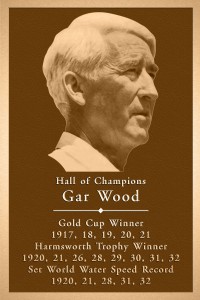
Garfield "Gar" Wood
One of the least remembered Detroit sports celebrities is speedboat champion Garfield "Gar" Authur Wood. He was known as the "Grey Fox of Algonac" by many in the speedboat racing world. He was the first person to go over 100 mph on the water. Gar Wood won five straight powerboat Gold Cup races between 1917 and 1921. He won the British International Trophy for Motorboats known as the Harmsworth Trophy nine times and retired from speedboat racing in 1933 to concentrate on business concerns.

Gar Wood was born in Mapleton, Iowa on December 4, 1880. His father was a patriotic Civil War veteran and named Gar after the current president James A. Garfield and his vice-president Chester Arthur. Gar was the third of twelve children. As a growing boy, Gar assisted his father who was a ferryboat operator on Lake Osakia in Minnesota. It is here where he learned his love of boating and developed his mechanical skill for inventing devices to solve mechanical problems.

Without any formal engineering training, Gar Wood invented the hydraulic lift for the titling beds of coal trucks in 1911 at the age of thirty-one. In addition to the dump truck, his company developed the self-packing garbage truck familiar in every corner of this country. In all, Gar Wood held over thirty United States patents making him a multi-millionaire by the age of forty.

Gar Wood and his eight brothers established the Wood Hoist Company which soon became Garwood Industries. Alongside industrial giants like Ford, Dodge, and Chalmers, the family built an industrial empire around the hydraulic lift which enabled Gar to pursue his love of speedboat racing.

In 1916, Gar Wood purchased his first motorboat naming it Miss Detroit. The following year he put a Curtiss "12" airplane engine in a speedboat against the advice of everyone and won the 15th Annual Gold Cup Race on the Detroit River. Fours years later, he set a new water speed record of 74.87 mph. In the next twelve years, he and his racing team built ten Miss America's and broke the water speed record five more times raising the speed to 124.86 mph on the St. Clair River in 1932.


Miss America X was the last of Gar Wood's racing boats. The $600,000 speed boat was powered by four 1800 horsepower, twelve cylinder Packard engines run in tandem in a double-hulled boat. The boat's stringers were made of top quality spruce with the rest of the boat made of mahogany. This was the first boat to go over two miles a minute using 10 gallons of fuel per mile when full open. After Wood won the international Harmsworth Trophy in 1932 and 1933, he retired from racing leaving his son to carry on the family tradition. Gar Wood did more to develop the American speedboat sport than anybody.

In the 1930s, Garwood Industries built a new boat plant in Marysville, Michigan capable of producing 1,200 quality custom boats a year. Their two basic commercial models were a 28' runabout and a 22' runabout. In all, the factory produced 10,000 boats before the company converted over to the war effort during World War II. The company had extensive military contracts for military hoists, hydraulic units, dump trucks, tow trucks, and transport trucks. After the war, Garwood Industries quit boat production in 1947.

In his later years, Wood worked on a commercially feasible, battery-powered electric automobile. His electric car used eight 12-volt lead batteries connected in a series to power two specially designed 90-volt, 2 hp DC motors. The top speed was 52 mph and cost about twenty cents to recharge the batteries. The car was named the Gar Wood Super Electric Model A and was featured in the July 1967 issue of Popular Mechanics.


Garfield Arthur Wood died from stomach cancer at the age of ninety on June 19, 1971 and was buried in Algonac, Michigan. Upon his death, Detroit News reporter George Van wrote, "To the public, he was Tom Swift, Jules Verne, and Frank Merriwell, with a little bit of Horatio Alger thrown in."

A short clip of Miss America X and Gar Wood in action winning the Harmsworth Trophy in 1932.
https://www.youtube.com/watch?v=CMlahrYMF74

Saturday, August 10, 2024

Brave New World of Betty Boop

Classic Betty Boop Sketch
Betty Boop was a music novelty character who was a sex symbol during the Great Depression. She was a caricature of Roaring Twenties flappers--young women who smoked cigarettes, drank alcohol, drove cars, and danced the Charleston in speakeasies. Betty Boop became known as the "Boop-Oop-a-Doop girl." Her personality can best be described as moxie.

Max Fleischer with his creation.
Betty was a creation of Max Fleischer Studios targeted for an adult movie audience during the 1930s. She wore short dresses, high heels, garters, and contoured necklines. Betty's "innocent sexuality" was a mixture of girlish naivete and vampish allure which some people would define as infantilizing women.

In 1932, jazz singer Cab Calloway performed in the famous film short "Minnie the Moocher" singing that evocation song while the video blended into a Betty Boop animation which defined her character and made her a star. This musical short was one of the original music videos and the song became Calloway's signature theme song for subsequent stage appearances.

As Betty's popularity progressed, many of her early cartoons found her fighting off predatory men trying to compromise her virtue, making some modern American women view Betty as a feminist icon against sexual harassment. By 1934, the Hayes Production Code forced animators to tame the Boop character by making her a ambitious career girl trying to make it in the big city. She began wearing appropriate business attire and less jewelry. The newer cartoons lost their edge and their popularity--the last of the original cartoons was made in 1939. The Betty Boop series gained a new audience when her cartoons were released for television making Betty an American cartoon superstar.


Helen Kane
Betty's "baby doll" voice was similar to the voice characterization of actress Helen Kane whose musical comedy stage career had faded by 1931. Kane brought a $250,000 infringement lawsuit in 1934 against Paramount Pictures for "deliberate caricature exploiting her personality and image."

Esther Jones
During the trial, it was discovered that African American cabaret performer Baby Esther (Esther Jones) used a similar vocal style in her Harlem Cotton Club act. Even the scat "Boop-Oop-A-Doop" was created by Jones as a vocal jazz improvisation. An early jazz novelty short film was found featuring Baby Esther performing her "baby doll" style. The New York Supreme Court ruled that the "baby doll" technique did not originate with Kane. 

Six different actresses portrayed the voice of Betty Boop. Two of them--Margie Hines and Mae Quistal were also the voice of Olive Oyl in the Popeye cartoons of the same era. 

Although the series ended in 1939, Betty's character appeared in two television specials in the 1980s, and she made a cameo appearance in the feature movie Who Shot Roger Rabbit? in 1988. Her image is still popular worldwide and has become a merchandising goldmine for King Features Syndicate.

Link to "Minnie the Moocher"

Saturday, August 3, 2024

Hoarders Henry and Clara B. Ford

Clara B. and Henry Ford

After Mrs. Clara Bryant Ford died at the age of eighty-four on September 29, 1950, lawyers, executors, and archivists discovered in the Ford family's Fair Lane mansion a massive accumulation of memorabilia and business documents tucked away in shoe boxes, desk drawers, file cabinets, and dressers.

Among their findings in the fifty-five room, greystone mansion were records from the earliest days of the Ford Motor Company (FoMoCo), 25,000 assorted photographs, bales of greeting cards tied with string, blueprints, contracts, maps, legal documents, personal letters, magazines, newspaper articles, and Henry Ford's "jot books."

Archivists filled 24 document boxes with Christmas cards alone and another 11 boxes with financial receipts for common household expenses from 1889 to 1950. Also found lying around carelessly was $40,000 in loose cash, 10,000 unopened letters, and many uncashed dividend checks.

Fair Lane Mansion

In their fifty-nine-year marriage, Henry and Clara lived in twelve different places before they built Fair Lane, and apparently neither of them ever threw anything away. Collectively, the treasure trove of documents was dubbed the Fair Lane Papers and occupied more than 700 feet of shelf space in double-tiered, steel document racks installed above the filled-in indoor swimming pool at the mansion. A full-time staff of sixteen historians, librarians, and archivists was hired by the Ford Foundation to organize and catalogue this vast, new documentary resource.

The operation was split into two units. The Records section was led by Dr. Richard Ruddell, a professional librarian whose team cataloged, annotated, and microfilmed over five million perishable papers and photographs. Their offices were on the main floor at Fair Lane.


The Living History section was led by Dr. Owen Bombard of Columbia University. His office was the master bedroom upstairs where Henry Ford had died six years before. The combined objective of both units was to assemble a rounded picture of the late industrialist.

Dr. Bombard set out to capture the living history about Henry Ford by interviewing and recording three hundred people who knew Mr. Ford. Participants were asked to share their tape recorded memories of the auto magnate. Only five people declined the invitation. Two people said they had nothing significant to add, and three former FoMoCo employees harbored resentment against the old man and did not want to be recorded.

On May 7, 1953, Detroit Free Press feature reporter Ed Winge asked Dr. Bombard in a interview if former Ford security chief Harry Bennett would be invited to record his memories for the oral history project. Bombard cautiously replied, "Bennett hasn't been approached yet. But he may be contacted in the future if it is felt that he has something to contribute."

For background, Harry Bennett published his autobiography in 1951 titled We Never Called Him Henry about his controversial years as Mr. Ford's right-hand man and company enforcer. The Ford family was united in their contempt for the former Ford Security chieftain, although a copy of his book is one of many books written about Henry Ford in the archive's collection.

Throughout the1920s and 1930s, Henry Ford was the world's best known American citizen. Because of the intense public and world interest in the enigma that was Henry Ford, his decendants opened the Fair Lane archives to historians, scholars, and authors. The Fair Lane Papers collection has since moved to the Benson Ford Research Center adjacent to Greenfield Village.

Henry Ford's Tough Guy--Harry Bennett 

Friday, July 5, 2024

The Long-Awaited Ambassador Bridge Connects Detroit with Windsor

Ambassador Bridge Announcement--Detroit Free Press

When the automobile business took off early in the twentieth century, the need for an international bridge connecting Detroit with Windsor to expand the auto industry and increase international commerce became apparent, but securing government funding for the bridge project was a hard sell fraught with political red tape and delay. The highest-profile person supporting the bridge project was automobile magnate Henry Ford. "The only way to get things done today is by private business," Ford said.

A team of Detroit business leaders incorporated the Detroit Bridge Company and sought out a former Detroiter, successful New York City banker Joseph A. Bower. Bower sold securities to finance the project and was able to raise $23.5 million in privately financed funds, including his own investment.

The project details were presented to the Detroit Common Council and approved unanimously. But one dissenting voice vetoed the project, Mayor John W. Smith. In additional to several ambiguities in the project's prospectus, including revenue for the city of Detroit, Smith was rightly concerned that the bridge deck would only be 135' above the Detroit River.

Mayor Smith, mindful of the future, realized that 135' would limit future navigation of larger freighters. The project engineers went back to the drafting table and re-engineered the bridge to be 152' above the water.

Recognizing the long-term value of the bridge and the threat any further delays might pose to the overall project and his substantial investment, Bower assumed the $50,000 cost of a referendum in a special election supporting bridge construction. The referendum passed by an eight to one margin on June 28, 1927. The next month, McClintic-Marshall engineering firm was awarded the bridge contact which ran from August 16, 1927 until August 16, 1930.

The penalty for late completion would require the firm to pay the interest on the securities until the bridge could generate revenue. If they finished construction early, they would be entitled to half of the bridge's revenue until the official end of the original contract. The newly christened Ambassador Bridge opened six months ahead of schedule despite having to change out the original suspension cables which were found to become brittle in freezing weather. They were quickly replaced with cables spun with stronger cold-roll steel. Still, the bridge cost came in 1% under the original budget allocation.

When finished, the Ambassador Bridge was 1.5 miles long, requiring 21,000 tons of steel. The clearance from the Detroit River was 152' but the bridge's roadway never rises above a gentle 5% grade. The four-lane roadbed (two coming and two going) was 47' wide with an 8' wide pedestrian sidewalk on the west side of the bridge. The bridge was anchored on the American side on West Jefferson and 21st Street. On the Canadian side, the anchorage touched down on London St and Huron Line Road in Sandwich, Ontario.

Opening day ceremonies coincided with Armistice Day (Veteran's Day) Monday, November 11, 1929. An estimated 100,000 from both sides of the Ambassador Bridge were on hand to cheer the ceremonial opening. With much pomp and circumstance, dignitaries from both countries held cermonies on their respective sides of the bridge. At 3:15 pm, Canadian bands played patriotic selections such as "God Save the King" and "Oh Canada," while at the same time, American bands on their side played tunes like "America" and "The National Anthem."

Following the musical programs, speeches were made by dignitaries on both sides of the bridge. Then, bronze "Friendship Tablets" designed by New York sculptor Jonathan M. Swanson were unveiled on the anchorages on both sides of the bridge. The plaques celebrated more than 115 years of friendship between the United States and Canada. The ceremony ended when dignitaries met at the exact international boundry. They shook hands and cut a white, silk ribbon. Then in concord, sirens and fog horns of river craft sounded continuous acclamation while many airplanes soared and circled above the bridge.

The bridge was originally scheduled to open in 1930 which is what the plaques reflect.

In what only can be described as a loosely controlled riot, joyous crowds on both ends of the bridge swarmed the deck. When the roadbed became so crowded that people could not move, some of the braver revellers climbed the construction catwalks on each side of the bridge to the top of the piers. It took well into the night before the bridge was cleared and secured again.

Photo from Windsor Star.

Four days later, the Ambassador Bridge opened for business. The opening was signaled by the passage of two cars filled with dignitaries from each country that left simultaneously from each side of the bridge. They honked in friendship as they passed at the center of the bridge and a signal cannon boomed to officially open the bridge to the toll-paying public. Cheers and applause broke out on both ends of the bridge.

The Ambassador Bridge was now officially open. An estimated 235,000 persons crossed the bridge the first day--35,000 of them were pedestrians. Traffic was backed up almost two miles on each bridge approach with people wanting to claim bragging rights that they had crossed on the first day.

On opening day, American customs officials reported that eleven quarts of whiskey were seized in three separate incidents. Prohibition was still in effect on the American side. At 8 pm, a man carrying four quarts, and at 9:15 pm, a woman carrying six quarts were detained by customs inspectors. Both people used the same excuse, they needed the whiskey to make holiday fruit cake." Just after 11 pm, a single quart was found tucked under the back seat of a car.

It was determined by customs agents that none of the instances was a commercial violation. The smuggled Canadian liquor was confiscated and the offenders were released after paying a $5 fine for each quart.

The Ambassador Bridge had the misfortune of opening just twenty-one days before the Great Depression struck. To compound the misery of the bridge's investors, the new Detroit-Windsor Tunnel opened downtown the following year charging lower automobile tolls. One factor remained in the bridge's favor though, the Detroit Bridge Company held a monopoly as the only Michigan international crossing for the commercial truck business.


When World War II broke out just over a decade later, American gas rationing dramatically cut automobile bridge traffic, but commercial truck traffic increased due to the war effort. In 1944, two years into the United States entry into the war, the Ambassador Bridge became profitable for the first time. Investors were paid 75 cents per share which began an unbroken stream of dividends every year since.

Gordie Howe International Bridge 

Thursday, June 20, 2024

A Brief History of the Gordie Howe International Bridge


With the installation of final edge girders on the Gordie Howe International Bridge on June 14, 2024, the long-awaited connection between the Canadian and United States sides of the Detroit River transpired.

This momentous occasion was the culmination of a nineteen year journey which began on June 15, 2005, when the Michigan Department of Transportation (MDOT) announced that a new international bridge was being proposed by a bi-national partnership between the United States Federal Highway Commission and Canada’s Ontario Ministry of Transportation. Its mission was to address “border crossing needs in Southeastern Michigan and Southwestern Ontario.”

Highway traffic research on both sides of the border indicated that the present Ambassador Bridge, which went into service over ninety years ago in 1929, was inadequate to meet the region’s future needs. The new bridge project originally known as the Detroit River International Crossing (DRIC) would have six lanes with an additional twelve foot wide pedestrian and bike lane, rather than the four lanes of the current Ambassador Bridge.

The cable-stayed bridge would have a 138’ clearance from the river and a total length of 8,202’ (1.5 miles). At its highest point of 722’, the bridge would rival the height of Detroit’s Renaissance Center. Two-hundred, sixteen spun steel cables will support the roadway and bear the traffic weight loads. The bridge will be illuminated at night with high-powered LED lighting.

The bridge plazas will have 24 primary inspection lanes and 16 toll booths. The port of entry and border inspection facilities on the United States side will have dedicated exit lanes to connect with Interstate 75, while the Canadian port of entry’s border inspection facilities and toll collection booths will directly connect to Ontario Highway 401.

Artist's rendering of Gordie Howe Bridge lit up at night.

Arguments in favor of the DRIC bridge were:

·       It would improve global trade between the two countries.

·       It would create an estimated 10,000 constructions jobs and 3,350 permanent jobs.

·       It would ease the daily traffic jams and border delays on both sides of the Detroit River.

·       It would save fuel, reduce air pollution, and minimize time lost, especially on the Canadian side where semi-trucks could avoid the gauntlet of city traffic lights leading to the Ambassador Bridge.

***

Major opposition to the DRIC bridge proposal came from the billionaire owner of the Ambassador Bridge, Manuel “Matty” Moroun, who made his fortune in the trucking industry and from collecting tolls on both ends of the bridge, including owning the Duty-Free shops.

The Ambassador Bridge is one of the few international, privately owned toll bridges in North America. While the Detroit/Windsor Tunnel downtown allowed passenger cars and buses through its crossing, the Ambassador Bridge became the only way commercial truck traffic could cross the Detroit River for almost 100 years, except for slow, obsolete ferry service. Matty Moroun purchased the Ambassador Bridge from the Joseph A. Bower family in 1979 and enjoyed its monopolistic status for over thirty years. Now, the DRIC threatened it.

Ambassador Bridge art deco plaque installed midspan.

Moroun used every legal delay his lawyers could devise and argued in the courts that his bridge had “exclusivity rights” granted to him by the previous owners. The courts summarily shut down that argument. In desperation, Moroun offered to build a six-lane twin span and use the old Ambassador Bridge for foot traffic and special events saying that his proposed project would be less expensive to build. The Canadians argued successfully that Mouron’s project would not solve the underlying traffic problems in the Windsor metropolitan area.

Moroun switched from the court battles to the political arena after losing a lawsuit brought by the MDOT in 2009 for his failure to construct new ramps to connect the Ambassador Bridge directly to Interstate 75 in violation of a previously negotiated contact. Michigan Republicans began voicing their support for Mouron and opposition to the DRIC bridge project.

Manuel "Matty" Moroun

In 2010, Moroun’s opposition to the new bridge prompted the Canadian government to offer to pay Michigan’s portion for the new span in exchange for collecting all tolls from the bridge for the next fifty years to reimburse Canada. Michigan Senator Alan Cropsey, Republican from DeWitt County, remained opposed to the Canadian offer. “The new bridge is unnecessary, and it would put an American businessman (Moroun) out of business. Is this some kind of foreign aid?”

Dan Stampler, president of Moroun’s Detroit International Bridge Company, warned that jobs created for the DRIC would go to Canadians casting doubt on Michigan’s Governor Jennifer Granholm’s loyalty as a Canadian born United States citizen for supporting the Canadian funding proposal. “She has offered to sell the Michigan border to Canada,” Stampler said.

Governor Granholm quickly refuted the broadside charge as “Totally absurd! When it comes to jobs and expansion on both sides of the border, this is the only game in town.” The political battle raged on.

In 2011, the Michigan Senate rejected a bill that would have allowed the state to accept a $550 million cash advance to fund the United States portion of the bridge construction. United States special interest politics interfered with the bill’s passage. The new Michigan Republican Governor Rick Snyder threw his support behind the DRIC bridge bill in his State of the State address telling his party that economic growth was his top priority. “It is time to solve problems,” he said.

In a last-ditch effort to enforce his will, Moroun promoted a proposal for an amendment to the Michigan Constitution requiring approval for the new bridge construction by not only Detroit voters, but also Michigan voters at large in statewide elections. The ballot proposal was defeated by a wide 60% to 40% margin. Mouron’s aggressive lobbying and litigating had worn thin with Michigan voters paving the way for the project to proceed.

***

On May 14, 2015 in a ceremony along the Detroit River on the Canadian side, Michigan Governor Rick Snyder, Canadian Prime Minister Stephen Harper, and Gordie Howe’s son Murray Howe jointly announced that the publicly owned DRIC bridge would be renamed the Gordie Howe International Bridge, after a native Canadian who played hockey for the Detroit Red Wings leading them to four Stanley Cup victories. Because of his prowess on the ice, Howe earned the nickname “Mr. Hockey.” In his remarks at the naming ceremony, Prime Minister Harper said, “Gordie Howe was a proud Canadian who built extraordinary goodwill between the two countries.”

On October 26, 2014, Howe had a stroke while at his daughter’s home. At the time of the naming ceremony announcement, Gordie Howe suffered from dementia and could not attend. His son told him about the honor bestowed upon him. Howe said, “That sounds pretty good to me.” Thirteen months later on June 19, 2016, he died at his son’s home in Sylvania, Ohio of undisclosed causes at the age of eighty-eight, two years before groundbreaking on the bridge began.

Howe’s casket was brought to the Joe Louis Arena for public visitation. The following day, his funeral was held at Detroit’s Cathedral of the Most Blessed Sacrament. Acting as pallbearers were hockey great Wayne Gretsky, winningest NHL coach Scotty Bowman, and Detroit Tiger legend Al Kaline. Howe’s remains were returned to Canada and interred in Saskatoon, Saskatchewan.

Mr. Hockey--Gordie Howe

***

Construction officially began on the Gordie Howe International Bridge in 2018, but the completion and opening have been delayed due to the COVID-19 pandemic in 2020. The long-awaited bridge opening is now scheduled for the fall of 2025 once the bridge plazas, signage, and traffic lights are installed. People on both sides of the Detroit River look forward with anticipation to the ribbon cutting ceremony marking the end of a twenty year odyssey.

Ambassador Bridge Opening Day Ceremony 

Saturday, June 8, 2024

Willow Run Bomber Plant Changes Ypsilanti Forever


Original Three-story Ypsilanti Depot Station.
At the turn of the century, before the second World War, Ypsilanti had an active downtown area along Michigan Avenue. Northeast of town, there was a thriving business district called Depot Town.

Depot Town was the area's commercial hub and provided services for weary train travelers. Ypsilanti's three-story brick depot station was ornate compared to the depot in Ann Arbor. In its day, it was said to be the nicest train station between Detroit and Chicago.

The Norris Building built in 1861 was across from the depot on River Street. It was originally supposed to house a retail block on the ground floor and residential rooms on the two upper floors. Instead, the building became an army barracks during the Civil War. The 14th Michigan Infantry Regiment shipped out of Depot Town in 1862, as did the 27th Michigan Regiment in 1863. 

The facade of the historic Norris Building remains on North River Street, despite a fire which decimated the rear portion of this last remaining Civil War barracks in Michigan. Renovated, the Thompson Building as it is now know is an important addition to the Depot Town community.

Michigan State Normal School was located west of Depot Town on West Cross Street and northwest of downtown Ypsilanti. It spawned a growing educational center which later expanded its mission to become Eastern Michigan University. 

Ypsilanti's residential area with its historic and varied architecture filled the spaces between. Surrounding everything was some of the most fertile farm land in the state.

The water-powered age of nineteenth century manufacturing on the Huron River gave way to the modern electrical age of the twentieth century. The soft beauty of the gas light was replaced with the harsh glare of the incandescent light bulb. The times were changing for Ypsilanti--ready or not.

***

The countryside was prime tillable ground with fruit groves scattered about the landscape. Henry Ford owned a large tract of land in an area known as Willow Run, named for the small river that ran through it. The Ford patriarch used the land to plant soybeans, but the United States government needed bombers for the Lend Lease program with Great Britain. On December 8, 1941, one day after the Japanese bombed Pearl Harbor, the Nazis declared war on the United States on behalf of their ally. America was drawn into the second world war.

The Roosevelt administration asked the Ford corporation, now run by Edsel Ford, to build a factory that could mass produce the B-24 Liberator Bomber. Edsel Ford, Charles Sorenson (production manager), and some Ford engineers visited the Consolidated Aircraft Company in San Diego to see how the planes were built. 

That night, Sorenson drew up a floor plan that could build the bomber more efficiently. His blueprint was a marvel of ingenuity, but the Ford corporation made one significant change in his master plan.

The best shape to build a front to back assembly line operation is in a straight line. But to avoid the higher taxes in Democratic Wayne County, the bomber plant took a hard right to the south on one end to stay within Republican Washtenaw County, which had lower taxes. This was at the insistence of Harry Bennett, Ford's head of security who had strong ties to Washtenaw County being a graduate of Ann Arbor High School.

The construction of the plant in Willow Run began in May of 1941, seven months before Pearl Harbor. Legendary Detroit architect Albert Kahn designed the largest factory in the world, but it would be his last project. He died in 1942.

The federal government bought up land adjacent to the bomber plant and built an airport which still exists today and is used for commercial aviation. The eight-sectioned hangar could house twenty Liberators.

***
Soon, workers flooded into Ypsilanti and the rapidly developing Willow Run area where makeshift row housing was hastily constructed. The Ford Motor Company recruited heavily from the South. By March 1, 1943, the bomber plant brought in 6,491 workers from Kentucky. That's when the derisive term "Ypsitucky" was first heard. But Ford recruiters also brought in 1,971 workers from Tennessee, 714 from Texas, 450 from West Virgina, 397 from Arkansas, and 314 from Missouri. In the most demographic shift in the area since the white man drove the red man west, the sleepy farming town of Ypsilanti went from a sunrise-to-sunset community to a three shift, around-the-clock, blue collar factory town. 

Suddenly the area was hit with a housing shortage. Ypsilanti homeowners rented rooms to workers or converted their large Victorian homes into boarding houses. It was wartime and money was to be made. Some families rented "warm beds." One worker would sleep in the bed while another was working his shift, but still there was a housing shortage. Many people slept in their cars until they could make other arrangements. 

Long time residents did not like the changes they saw in their town. The bomber factory workers worked hard and drank hard. Fights broke out in local bars, often over women. Ypsilanti developed a hard edge and a dark reputation.

Because so many men were in uniform serving their country, there was a shortage of skilled labor at first. But then the women of Southern Michigan stepped up big time. To make up the labor shortfall, they donned work clothes, and tied up their long hair in colorful scarves collectively earning the nickname "Rosie the Riveter". It was calculated that by the end of the war, 40% of every B-24 Liberator was assembled by women.

***

Little known factoid: The first stretch of expressway in America was made with Ford steel and Ford cement. It connected workers in the Detroit area to their jobs at the bomber plant in Willow Run via Ecorse Road. It's still there and runs along the north end of the former GM Hydromatic Plant and Willow Run Airport.

***

The Yankee Air Museum housed on the east end of Willow Run Airport was established in 1981 to restore and preserve the almost forgotten history of Willow Run Airport, and to commemorate the achievement of the men and women who helped win the war by the sweat of their brow producing 8,685 B-24 Liberators.

***

Background history of the Yankee Air Museum: http://yankeeairmuseum.org/our-history/

Rosie the Riveter short: https://fornology.blogspot.com/2013/03/rosie-riveter-happy-womens-history.html

The following link has some vintage bomber plant footage: http://www.annarbor.com/news/ypsilanti/pbs-to-air-documentary-about-ypsilantis-legendary-willow-run-b-24-bomber-factory/

Tuesday, March 26, 2024

Detroit's Movie Maven--Bill Kennedy


Bill Kennedy at the Movies with Sir Graves Ghastly. Sir Graves would riff on his monster movies and Bill would dish on Hollywood and the movie business.

Every Baby-Boomer from Detroit and Windsor remembers who gave us our extensive Hollywood movie education--Bill Kennedy. Bill started announcing on the radio professionally in the 1930s at WWJ - The Detroit News station. His deep voice resonated over the air waves.

In 1940, he embarked on a movie career and signed a contract with Warner Brothers Studios where he worked from 1941 until 1955. Bill had the voice but not the face. He didn't emote well on screen, so he was relegated to a series of flat supporting roles. He played mainly cops, bad guys, radio announcers (no stretch for Bill), newspaper men, and swindlers. In all, Bill Kennedy has 103 film credits.

In the post World War Two era, Kennedy appeared on numerous B-Western television shows including The Lone Ranger, The Cisco Kid, and The Gene Autry Show. Kennedy always spoke kindly of Gene Autry. Bill was over six feet tall and many of Hollywood's leading men were short and didn't like doing fight scenes with him. Gene Autry was short, but always had a job for Bill when he needed it. Autry told him once, "I like beating up bad guys on screen who are bigger than me."

Bill Kennedy playing a newscaster in a Superman episode.

What many of us in Detroit know that most people don't is Bill's was the voice behind the opening credits of  The Adventures of Superman--one of the most iconic introductions in television history. Bill received a one-time check for $350. He regretted not asking for screen credit which might have benefited his career. The show has been continuously running in syndication since 1952. A link to the Superman program opening is below.

In 1956, Bill Kennedy returned to the Detroit area to host an afternoon movie program called Bill Kennedy's Showtime, for CKLW-TV across the Detroit River in Windsor, Ontario. The show became a big hit. Bill talked about his jaded experiences in Hollywood's heyday and how he worked with many of the top stars. His deadpan delivery and sarcastic wit won the loyalty of viewers. He had an avuncular, self-deprecating manner--especially if talking about a film he was in. If the movie was bad, he would tell his audience.

The show opened with a tight shot on a picture of a woman smoking a cigarette with Bill's theme song Just in Time playing in the background. The photograph was from a magazine. I can see the model in my mind's eye with her elbows on a table and a smoldering cigarette in her right hand. Bill chose Just In Time for his theme song because his professional life was at a low point when he got the job with CKLW.

Bill wearing a hat to cover up his hair transplant surgery.
In 1969, Bill took his show to WKBD which broadcast out of Southfield, Michigan. The show remained essentially the same with a title change to Bill Kennedy at the Movies. Bill would interview celebrities when they were in Detroit and he took on-air phone calls which were sometimes more interesting than the movies. I enjoyed the live TV commercial pitches of Abe Schroe for his furniture upholstery business.

Abe and Bill always had lively repartee like they knew each other well outside of work. These two got along so well on air that it strikes me Bill was probably part-owner or an investor in Artistic Upholstery. Bill would take a break and Abe would go into his pitch. Nobody else made live commercials on Bill's show--not Ollie Fretter--not even Mr. Belvedere (Detroit inside joke).

In 1983, Bill retired to Palm Beach, Florida. He died of emphysema on January 27, 1997, at the age of eighty-eight. Rest in peace "young, old-timer."

The Adventures of Superman introduction: https://www.youtube.com/watch?v=Q2l4bz1FT8U

Bill Kennedy's theme song Just In Time by Frank Sinatra. https://www.youtube.com/watch?v=RIcQ26arWAs